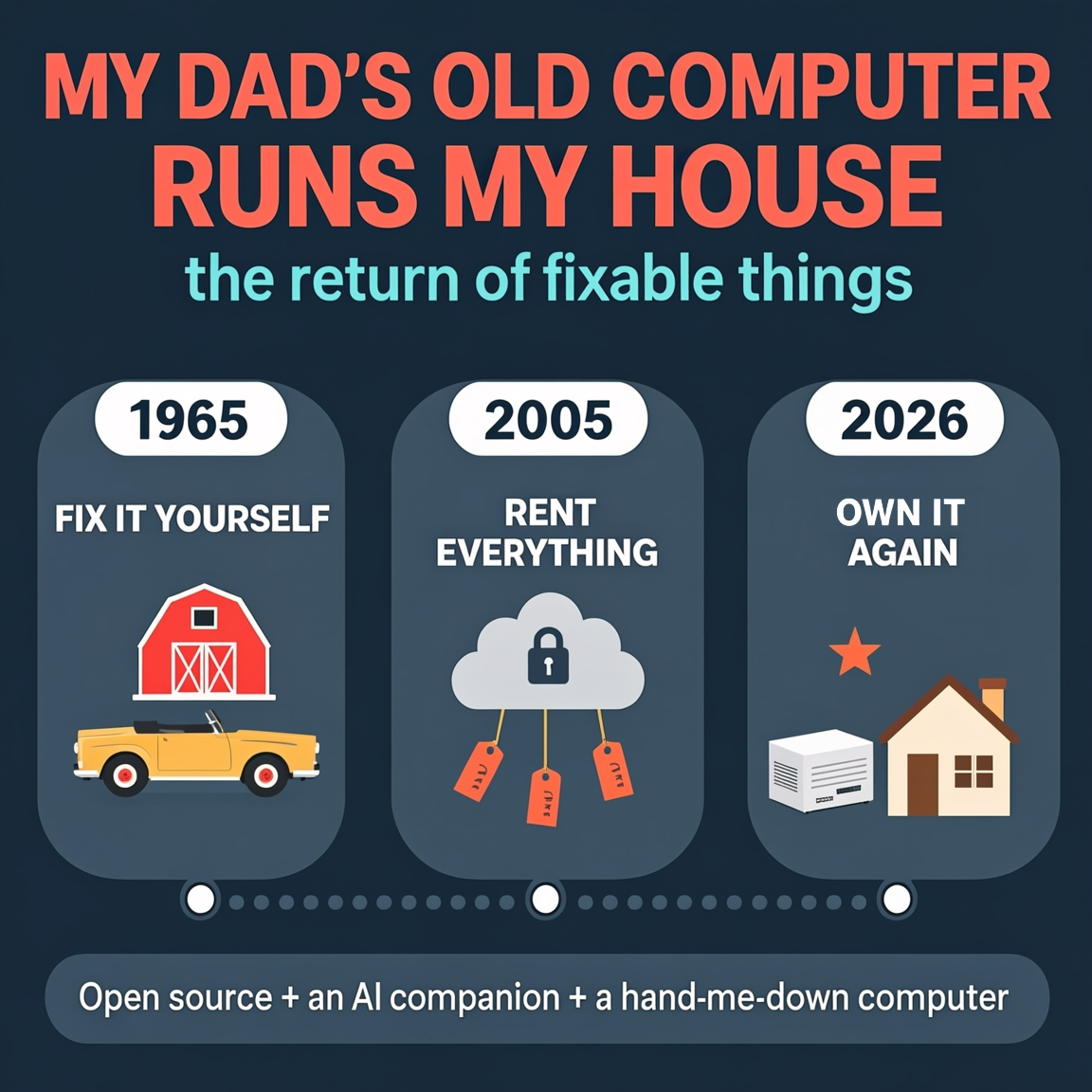
There is a small computer in my house that used to belong to my dad. A Mac mini - a silver box the size of a sandwich. He was not using it anymore, and rather than let it sit in a drawer, I gave it a name, Ada, and a job. Tonight, while I sleep, it will tidy the 143-page wiki that holds everything my systems know, check the cameras, and leave notes about what it did. It runs the house now.
My dad grew up on a farm in southern Minnesota. On a farm, you fix the machine yourself, because the machine is yours and the dealer is far away. He once drove a yellow Corvair to Montreal with a broken starter; he and his friend push-started it the whole way home, one pushing, one popping the clutch. I think about that car a lot lately, because something like that spirit - it is mine, I will fix it - just became available to people like me, who cannot pop the clutch on anything.
I am writing this from a hotel in Seattle. My computers are 1,400 miles away in Minnesota, and I have used them every day this trip, from my phone. To explain how is to explain a small system. An app called Blink is the front door. A private network ties every device I own into one room no matter where they are, and a connection trick called mosh keeps the session alive through elevators and airplane wifi. The actual work is done by an AI assistant named Claude, which lives on the machines. The wiki is the memory that holds what we figure out. I text my computers the way you text a person. "Pull the numbers from those receipts into a spreadsheet." "Find the moment in this two-hour graduation video where her name is called." The assistant found the name at 1:59:29 and cut a clip of her walk across the stage.
That is the setup. The story is what it replaced.
The dying part
This February, the financial press started using a word I did not expect to see outside a sermon: the SaaSpocalypse. In one 48-hour stretch, about $285 billion evaporated from the valuations of software-as-a-service companies - the firms that rent you software by the month. Over a single month, the sector lost roughly $2 trillion. The trigger was AI that can do the work itself: once it can, paying monthly for a tool that merely helps a human do the work stops making sense. I read the coverage with a strange feeling of recognition. A slow-motion version of it had already happened in my house.
The loud corporate version of this story has already produced its cautionary tale. Klarna, the payments company, announced it was shutting down Salesforce and Workday and replacing them with AI. The reality turned out softer - the CEO later admitted they "did not replace SaaS with an LLM," and the company quietly rehired human customer service agents after the all-AI version produced what he called lower quality work. Big companies will be sorting this out, expensively, for a decade.
But there is a quiet personal version of the same story, and it actually works. It is happening in basements, on hand-me-down hardware, one canceled subscription at a time. The self-hosting world - people running their own photo libraries, their own note systems, their own networks - used to be a hobby for professionals, because the price of admission was knowing how. AI assistants collapsed that price. You no longer need to be a system administrator; you need to be able to describe what you want and read what comes back.
In my house it went tool by tool, and I can tell you exactly where subscriptions died. They died wherever the product was standing between me and my own stuff. My network is the clearest example. Most people who want my kind of setup use a free service called Tailscale, and it is excellent - but then the map of my devices - what I own, where it is, what may talk to what - would live in someone else's database. The assistant suggested the version you run yourself, called Headscale, and installed it on a small cloud server I already rent. Same function. Different relationship.
And I can tell you where subscriptions are still very much alive, because I still pay them. I rent the cloud server itself - the landlord owns the building; everything inside is mine. I pay Apple for the developer account that lets me put my own app on my own phone. I pay for the AI. Renting survives where something genuinely is shared - other people's hardware, other people's risk. It dies where the only thing being shared was the vendor's convenience.
The living part
What replaces the dead subscriptions is not new software. Mostly it is old software - open source, the kind with published blueprints that anyone may copy and change. Open source has always been the alternative, and it always carried the same asterisk: free, if your time was worthless. The blueprints were public, but reading them was a profession.
That asterisk is what just changed. The terminal app on my phone is my own copy of an open-source project called Blink. I wanted it to take orders from Siri and ping my lock screen when a job at home finishes, so the assistant and I built that, working on Ada - my dad's old computer writing new features for my phone. I decided what to build and reviewed the work; the assistant did the parts I did not know how to do.
The deeper change is in maintenance, which was always open source's hard problem. Volunteer maintainers burn out; nobody wants to fix the boring bugs. Now the help arriving is not just labor but computing power. OpenAI runs a fund offering maintainers up to $25,000 in AI credits; GitHub's Maintainer Month now includes companies donating AI time and computing power the way others donate money. And it scales down to one person: if a tool I rely on has an annoying bug, I can point my own assistant at it, lend my own credits, and send the fix back. You no longer have to know how to code to leave the campsite better than you found it. Open source, fifty years old, turns out to have been waiting for a reader fast enough to make its freedom practical.
The part that outlives its engine
Here is the strangest part. The AI model that built most of my infrastructure is not the one maintaining it. The network, the forked app, the wiki itself - most of that was built this spring with a model called Opus. The model helping me now is called Fable; it arrived later. This morning, Fable fixed a small fault in the network Opus built, after reading the notes Opus left in the wiki.
Software products die when their company dies, changes direction, or raises the price. My collaborators die too - models are replaced every few months. The difference is what survives. When a subscription product dies, you lose the tool and often your data with it. When my model is replaced, the new one sits down, reads the wiki, and continues - because the memory was never in the model. It is in pages I own, on machines I own, documented well enough that any sufficiently smart successor can pick up the thread. I used to depend on companies' continuity. Now I depend on my own notes. Even the AI itself, the one subscription at the center of all this, is replaceable the same way: the notes would work with any capable model, and smaller models already run on my own machines.
The sandwich-sized inheritance
My dad fixed his own machines because that is what you did on a farm. Then came fifty years of machines you could not fix - sealed, licensed, rented, serviced by someone else. His generation watched ownership recede. What I did not expect was to watch it come back, or that it would come back through his own computer: a sandwich-sized box on a shelf in Minnesota, running my household, fixing the network, taking its instructions from a phone in Seattle - one of us pushing, one of us popping the clutch.